How to Draw Plan in Autocad 2017
Brandish ane or more scaled views of your design on a standard-size drawing sheet chosen a layout.
After y'all finish creating a model at full size, you can switch to a paper space layout to create scaled views of the model, and to add notes, labels, and dimensions. Y'all can also specify different linetypes and line widths for display in paper space.
Model Space and Paper Infinite
As you know, you create the geometry of your model in model space.

Originally, this was the but space available in AutoCAD. All notes, labels, dimensions, and the drawing border and championship block were as well created and scaled in model infinite.
After paper space was introduced, you could click a layout tab to admission a infinite designed specifically for layouts and scaling. In the following illustration, paper space is active. At that place are currently only ii objects in paper space: a drawing border block, and a single layout viewport, which displays a view of model space.
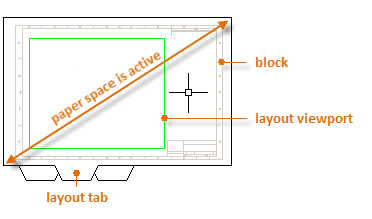
Working with layout viewports is described in more detail later in this topic.
Four Methods for Scaling
There are four different methods in AutoCAD that are used to scale views, notes, labels, and dimensions. Each method has its advantages depending on how the drawing will be used. Here'south a brief summary of each of the methods:
- The Original Method. You create geometry, comment, and print from model space. Dimensions, notes, and labels must all be scaled in opposite. Yous set the dimension scale to the changed of the plot scale. With this method, scaling requires a fiddling math. For example, a mutual calibration used in architecture is one/4" = 1'-0" which is ane:48 scale. If a note is to be printed 1/4" high, then it must be created 48 times equally large, or 12" high in model infinite. The same scale factor also applies to dimensions, and an ARCH D drawing border at that calibration is 144 feet long. When the drawing is printed as a D-size sheet, everything scales down to the right size.
Annotation: Many AutoCAD drawings were created with this method, and many companies still use it. Once everything is fix, the method works well for 2D drawings with unmarried views and inserted details.
- The Layout Method. You create geometry and annotate in model space, and print from the layout. Set the dimension scale to 0 and the dimensions will scale automatically.
- The Annotative Method. You create geometry in model space, create annotative dimensions, notes, and labels (using a special annotative style) in model infinite from the layout, and y'all print from the layout. Annotative objects display merely in layout viewports that share the aforementioned scale. The dimension calibration is automatically set to 0 and all annotative objects scale automatically.
- The Trans-Spatial Method. Y'all create geometry in model space, create annotations in paper infinite on a layout with dimension scale gear up to 1, and y'all print from the layout. This is arguably the easiest, nigh direct method, and information technology is the method of choice for this guide.
Talk to other AutoCAD users in your discipline about these four methods and why they chose the method that they utilize.
Specifying the Paper Size of a Layout
The starting time thing that you should practice when you lot access a layout tab (1) is right-click the tab (2) and rename information technology (3) to something more specific than Layout ane. For a D-size layout, Curvation D or ANSI D might be skillful choices.

Next, open the Page Setup Manager (4) to change the paper size displayed in the layout tab.
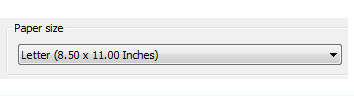
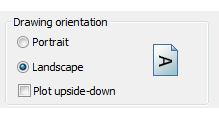
Annotation: Yous might be wondering why there are ii entries in the list for every sheet size. This is because some printers and plotters do not recognize the drawing orientation setting.
Layout Viewports
A layout viewport is an object that is created in paper infinite to display a scaled view of model space. Y'all can think of it equally a airtight-excursion Tv set monitor that displays part of model space. In the illustration, model infinite is active and accessible from within the current layout viewport.

In a layout, when model space is agile, yous tin can pan and zoom, and annihilation else that you lot could do on the Model tab.
Of import: You can switch between paper space and model space by double-clicking within or exterior the layout viewport.
For example, let's say that you created a backyard deck design in model space, and now you desire to lay out and print your pattern from a layout tab.

The view in the layout viewport is not however gear up to the correct calibration.
Annotation: You lot can use the MVIEW (make view) control to create additional layout viewports in paper space. With several layout viewports, you tin brandish several views of model space at the aforementioned or at different scales.
Scaling Views and Trans-Spatial Notation
Here are the steps to follow if you use the trans-spatial method of annotating your drawing:
- Click the layout tab. If yous started the drawing with your ain custom drawing template file, several tasks might already have been completed: the layout might already be prepare to D-size, and the title block might already have been inserted in the layout.
- By default, paper space is active, and so double-click within the layout viewport to make model space active. Notice that the edge of the layout viewport becomes thicker as a result of switching to model space.
- Zoom out and center the model space view by panning. However the displayed view is still not set to the correct scale.
- Double-click outside the layout viewport to brand paper space active again.
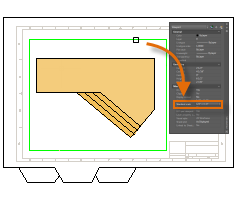
- Open up the Properties palette so click to select the edge of the layout viewport.
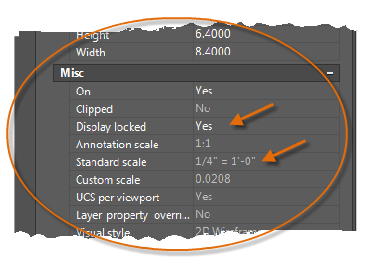
- In the Properties palette, specify a standard scale of one/4" = i'-0" from the drop-downwards list. This activeness scales your view of model infinite precisely to the D-size drawing. You also gear up the Display Locked property from No to Yes. This prevents whatever unintentional brandish changes to the view.
- Move the layout viewport as needed, and adapt its edges using grips.
- Create notes, labels, and dimensions directly in paper space. They automatically appear at the right size.
- Plow off the layer on which you lot created the layout viewport object. This hides the edges of the layout viewport equally shown below.
- Print the drawing to paper or as a DWF or PDF file.
Note: By default, the dashes and spaces in a not-continuous linetype appear at the aforementioned length regardless of the scale of the layout viewport.

Notation: After you have finished dimensioning, you lot can use the EXPORTLAYOUT command to merge everything in model and newspaper space into the model space of a separate drawing file. This operation creates a drawing file that conforms to the original method of creating the model and all annotations in model infinite.
Source: https://knowledge.autodesk.com/support/autocad/learn-explore/caas/CloudHelp/cloudhelp/2017/ENU/AutoCAD-Core/files/GUID-DF5C5E9A-113E-456E-AFC4-4CEDAEE60A78-htm.html
0 Response to "How to Draw Plan in Autocad 2017"
Post a Comment