Inventor Which Plane to Draw on
Yous tin edit views, specify how they appear, and create drawing views of sketches and sheet metal parts.
Edit Cartoon Views
You tin can modify the label, calibration, display style, and other attributes of a drawing view. If advisable, you tin select a different view representation.
Note: If the Calibration from Base or Style from Base selection is selected, the calibration or display mode cannot exist changed for a child view.
Yous can delete a drawing view or copy and paste a view to another sheet. If you delete a view with dependent projected, section, detail, or auxiliary views, they are automatically deleted.
- In the graphics window or the browser, select the view.
- Correct-click and select Edit View from the menu.
- In the Drawing View dialog box, on the Components tab, modify the options related to the source model, or any of these additional options:
- Change the model representations.
- Change the view display style.
- Edit the view label.
- Switch the visibility of the view characterization on or off.
- Click Edit View Label and edit the view label in the Format Text dialog box.
- Select or enter a view scale.
- If you lot are editing an assembly drawing view (not available in Inventor LT), you lot can do whatsoever of the post-obit:
- To change the pattern view representation, click the pointer, and select a design view representation from the list. Select the Associative checkbox to acquaintance the cartoon view with the blueprint view representation in the model.
- If appropriate, select a different positional representation.
- For an iAssembly factory, select the member to correspond in the view.
- Select a level of detail representation to improve view generation by using only unsuppressed components in the view.
Associative Blueprint View Representations
Component transparency is stored in a view representation. A drawing view, that is associated
 with such a blueprint view representation, uses the component transparency setting from the view representation. If your workflow uses associated views, view representations are the preferred method for managing drawing view occurrence display.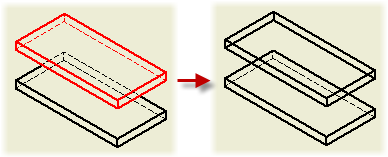
Component transparency can be assigned at the view level for non-associated drawing views or by using the component level option "Legacy Transparency." The drawing component setting overrides the model component appearance. This is for non-associative drawing views only.
- On the Model State tab, alter the weldment state, reference options, or hidden line calculation options. (Available options depend on the blazon of file used to create the view.)
- On the Brandish Options tab, change attributes of brandish characteristics.
- When you edit a base view, utilise the straight-editing tools in the graphic window to edit view properties. You tin can alter view orientation, scale, position, or to add and remove projected views.
- Click OK to close the Drawing View dialog box.
Customize Drawing View Orientation
You can customize the orientation of a new or existing view.
Drawing view orientation is ordinarily derived from the orientation of the model. When yous create a base view, you lot can employ the view cube to change the model orientation. To create a specific custom orientation, employ the Custom View environment.
- Do one of the following:
- Correct-click the View Cube, and click Custom View Orientation to enter the Custom View surroundings.
- Use the Custom View tab to set the view orientation. For example:
- Click Custom View tab
 Exit console Finish Custom View to accept the view orientation and shut the Custom View window.
Control Cut inheritance in Child Views
Isometric projected views created for section views inherit the section cut past default. Orthographic projected and auxiliary views support the inheritance of the section, but it is switched off by default.
Isometric projected views created for views with a breakout inherit the breakout cut by default. Orthographic projected and auxiliary views practise not support the inheritance of breakout operations.
For orthographic projection, child views inherit breaks by default if the view project direction is parallel to interruption lines.
- In the graphic window or the browser, select the child view.
- Right-click and select Edit View.
- On the Display Options tab of the Drawing View dialog box, select the advisable checkboxes in the Cutting Inheritance section. The selected cuts are inherited from the parent view.
Suppress or Unsuppress a Drawing View
The Suppress option specifies whether a drawing view is visible or suppressed. It provides a college level of visibility control, which supplements the visibility control for components, annotations, model edges, and layer visibility.
Suppressing several drawing views also increases the functioning of drawings created for large assemblies.
The Suppress attribute affects all model-generated geometry (visible and hidden edges, thread edges, tweak trails) and annotations attached to the selected view (view sketch, dimensions, symbols, centerlines). View visibility suppression is not available for overlays and breakouts.
- When a section view is suppressed, section view sketch (profile) is subconscious in the parent view.
- Breakouts hide, if the parent view is suppressed.
- The parent view controls whether an overlay view is visible.
- Exercise one of the following:
- To suppress a drawing view, right-click a drawing view in the Model browser or in the graphic window, and then in the menu, select the Suppress option.
- To unsuppress a drawing view, right-click a cartoon view in the Model browser, and unselect the Suppress option.
Motion or Copy Views to Other Sheets
If you place a dependent view on a dissimilar sheet than its parent view, a projection line appears next to the parent view. The browser lists the dependent view under its parent view with a shortcut icon.
- To display the dependent view, double-click the shortcut icon.
- To re-create views, select views in the browser or display, then right-click and click Re-create or use Ctrl+C. To paste you can do either of the post-obit:
- In the browser, select the canvass node and use Ctrl+V or correct-click the canvass node and click Paste.
- In the display, position the cursor within the sheet purlieus and use Ctrl+C or right-click inside the sheet boundary and click Paste.
- To motility views, in the browser, click the view and drag it to a dissimilar sail node.
- To identify a view in a new sheet, click Place Views tab Sheets console New Sail so move or re-create the view to the sheet.
Check in the browser to verify that the copy is placed on the new sheet. If it is not visible on the sail, it may be "behind" another view. Click and elevate the views to reveal it.
Create a Cartoon View of a Sketch
Yous tin can include consumed and unconsumed 2d and 3D sketches in drawing views, fifty-fifty if there is no solid body in the role file. Except for reference parts, a sketch node is created in the cartoon browser using the default name of the sketch.
2D sketches are visible but in base of operations views and must exist parallel to the view.
When you utilize 3D sketches in drawing views:
- Sketch dimensions are not visible.
- Sketch geometry is not included in hidden line calculations.
- Child views inherit visibility, and sketch inclusion or exclusion from the parent view.
- Sketch nodes in the browser have no Properties option.
- Suspension-out, detail, and section views trim sketch geometry the same as other model geometry.
In drawing views of parts that contain both solid bodies and sketches, the sketches are non visible by default. If the part file has no solid bodies, sketches are automatically visible in drawing views.
Sketches are not automatically visible for associates views(not bachelor in Inventor LT). Correct-click the model in the browser and select Get Model Sketches. Sketches consumed by assembly features cannot be displayed in a drawing view.
If you create a sketch in the drawing, it is non possible to make boosted views from this sketch.
- On the ribbon, click Identify Views tab Create panel Base and so open a file that contains simply sketches or a mixture of sketches and solid bodies.
- In the graphics window, click to identify the view.
- (Optional) To add sketches to a view, correct-click the sketch node in the browser and select Include. The browser icon changes colour to indicate the sketch is visible.
- (Optional) To change the visibility of a sketch in a view, right-click the sketch icon in the browser and select or clear the check mark of the Include pick.
- Continue to add views every bit needed.
 Show Me How to Utilize a Bitmap on Shaded Views to Increase Capacity and Performance
Update Cartoon Views and Sheets
When significant changes take been made to a drawing, Global Update is the default choice.
If you do not want to trigger Update automatically, yous tin manually update drawings while y'all work. The Update command dims when the file is fully up-to-engagement.
- On the Quick Admission toolbar, click the arrow abreast Update.
- Select the advisable option: (not available in Inventor LT)
Suit the Position of a View on a Sheet
Yous can drag to re-position a single view or multiple views in a option window.
When you lot drag to select views, if you get-go in in the upper-right corner and drag diagonally from right to left, you include all views that the selection window touches. Dragging diagonally from left to right includes only views that are fully enclosed in the window.
You lot can also go on the relative position of the view characterization by constraining it to the view purlieus.
- If y'all are re-positioning multiple views, elevate to select them.
- Click and drag the ruddy edge for the single view or the selection window.
- (Optional) To go on the relative position of the view label, select the Constrain to View Border pick on the View Preferences tab of the Standard console in Fashion and Standard Editor.
Redefine XY Planes to XZ Planes
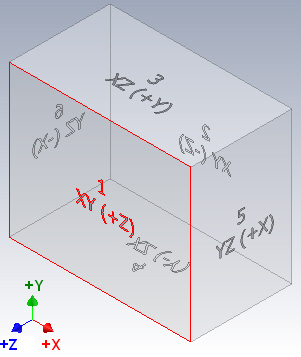
The view orientation (Front, Top, Left, Right, and so on) existence used in IDW, Autodesk Inventor View, and 3D DWF are divers past the following mappings.
This is the default isometric view in the English language template:
This is the Default isometric view in the Metric template:
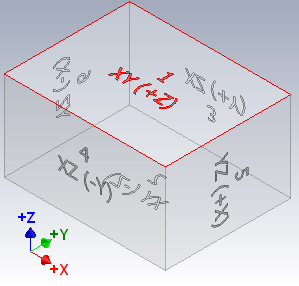
The mapping is fixed and cannot be changed.
The table refers to the parts origin plane when placing a drawing view. For instance, XY (+Z) means that yous look at the XY Plane from +Z.
Redefining the isometric view in an .ipt (or .iam (in Inventor) file does not impact the mapping.
| Origin folder in IPT (and IAM Inventor) | View orientation in IDW, 3D DWF, and Autodesk InventorView |
|---|---|
| XY (+Z) | 1 = Front |
| XY (-Z) | ii = Dorsum |
| XZ (+Y) | 3 = Top |
| XZ (-Y) | 4 = Bottom |
| YZ (+X) | five = Correct |
| YZ (-10) | 6 = Left |
- If the ViewCube is not displayed, click View tab Windows panel User Interface , and select ViewCube.
- Utilize the ViewCube to reorient the view.
- Right-click the ViewCube and select Set Current View every bit Home.
Source: https://help.autodesk.com/cloudhelp/2020/ENU/Inventor-Help/files/GUID-5205F5D9-B87E-41DC-9670-0DA8668EDE67.htm#!
0 Response to "Inventor Which Plane to Draw on"
Post a Comment